Last updated: November 12, 2026
Selling Land Next to an Existing Data Center: Is Your Parcel Worth More?
When a data center goes up beside your property, two things tend to happen. Neighbors start telling you your land must be worth a fortune now, and sooner or later someone calls asking whether you would sell. Sometimes the neighbors are right. Often the story is more complicated, because what makes a campus valuable is power and zoning, and neither one crosses a property line on its own. This page explains when adjacency really helps, when it does not, and how to prepare.
Quick answer
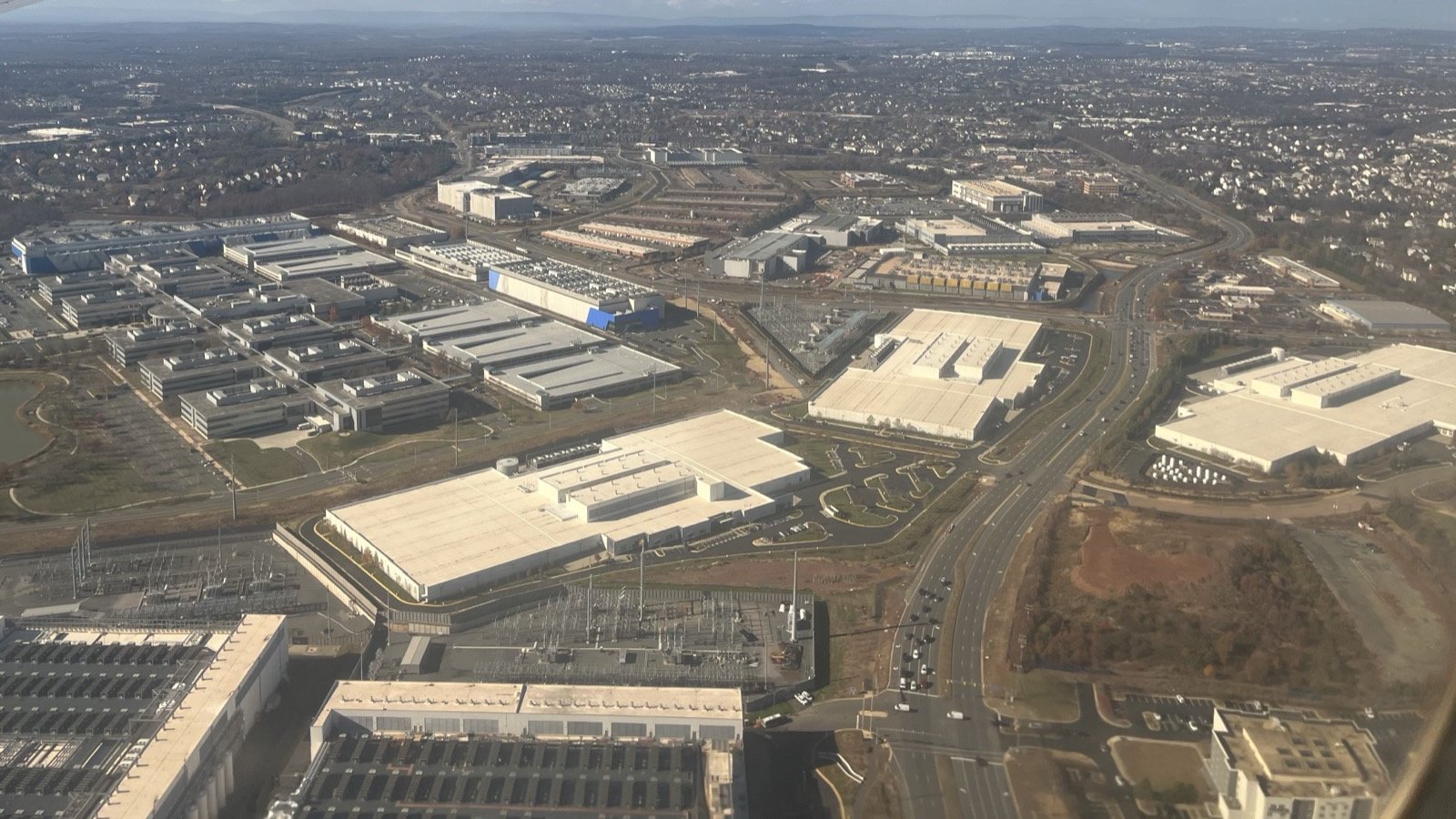
Land beside an existing data center often gets more buyer attention than land in the open, mostly from the operator next door looking for room to expand. Whether it is worth more depends on whether the campus’s advantages carry over to your parcel: spare utility capacity, zoning that allows a data center on your land, usable contiguous acreage and distance from homes. Being next door can also cut the other way. Busy clusters are where utilities hit transmission limits first and where counties tighten zoning first, as Loudoun County, Virginia showed in 2022 and 2025. Treat adjacency as a reason to do your homework early, not as a price.
Why Operators Look Next Door First
Data center campuses are usually built in phases. An operator buys enough land for the first buildings, plans for more, and then finds that demand moves faster than the plan. When that happens, the cheapest and quickest land to add is often the parcel that touches the existing site.
There are practical reasons for that. An adjacent parcel can share the campus security perimeter, internal roads, fiber routes and, most importantly, the electrical infrastructure the operator has already paid for or committed to. The operator already knows the local permitting staff, the utility account managers and the community issues. And buying the land next door keeps a competitor, or a housing developer, from building against its fence line.
That is why the most likely buyer for land beside a campus is the company that owns the campus. It is also why that buyer starts the conversation with an information advantage: it knows how much capacity it has left, what its utility has told it about future load, and how many other parcels around the site it could buy instead of yours.
What Makes an Adjacent Parcel Actually Useful
Shared substation or a new one being built
A campus substation, or a utility project to build one, is the clearest sign the area is being served at data center scale. Whether any of that capacity is spoken for is the follow-up question.
Transmission lines crossing or bordering your land
Lines that already serve the campus may make your parcel easier to connect, or may come with easements that limit where buildings can go. Both matter to a buyer.
Same zoning district as the campus
If your parcel shares the campus zoning and plan designation, a buyer has a shorter path. Different zoning means a rezoning or special exception, which takes time and public hearings.
Contiguous, usable acreage
Operators value land they can fold into the existing site plan. A parcel that wraps around the campus, or connects it to a road, can matter more than its acreage suggests.
Distance from homes
Generators, cooling equipment and noise limits make setbacks from residences important. A buffer of open land, or no houses on the far side of your parcel, makes an expansion easier.
Road frontage and truck access
Transformers and switchgear arrive on oversized loads. Frontage on a road that already handles the campus traffic is useful.
None of these is a guarantee on its own. A substation on the far side of your fence can be fully committed to the campus it was built for. That is why the conversation with a buyer usually turns, sooner or later, to what the utility will commit to in writing. Our guide to land near substations covers how distance and capacity interact, and utility will-serve letters explains the document that settles the question.
When Next Door Is Not Enough: The Loudoun Power Crunch
The clearest public example of adjacency failing as a shortcut comes from the largest data center cluster in the world. In July 2022, Dominion Energy told data center customers that transmission constraints in a pocket of eastern Loudoun County, Virginia would limit new data center connections. Ashburn District Supervisor Mike Turner wrote in his August 5, 2022 newsletter that Dominion had advised it would likely be 2026 before new Electricity Service Agreements were issued for data centers in the affected area.
Dominion later resumed connections on an incremental basis, but reporting from Data Center Frontier and DatacenterDynamics at the time said a county report put the constraints on two-thirds of Loudoun’s substations and most of its projected data center growth, and that some planned projects could be held up for as much as four years. The fix Dominion described was new transmission, including a 500 kV line in southern Loudoun expected in 2026.
For a landowner, the lesson is simple. A parcel can sit within sight of dozens of operating data centers and still be years from power, because the limit is the grid serving the area, not the distance to the nearest building. In a busy cluster, the question “how close is the substation?” matters less than “what capacity is left, and when?” Our page on what interconnection queues mean for landowners explains how that capacity gets allocated.
Site intake
Own land that borders a data center campus?
Data center developers are paying premiums for powered land — get a realistic read on your parcel. Free, no obligation unless a deal closes.
Send the address, acreage and what you know about zoning and nearby utility lines. We review it against the criteria data center buyers use. A submission is not a listing and does not obligate you.
Your information is reviewed privately. A submission is not a listing, and it does not obligate you unless a deal closes.
Zoning Does Not Cross the Fence
The campus next door got its approvals under the rules in place when it applied. Your parcel will be judged under the rules in place when a buyer applies, and those rules are changing fastest in exactly the places where data centers already cluster.
Loudoun County is again the example. On March 18, 2025, its Board of Supervisors approved a zoning ordinance amendment requiring special exception approval for data centers in the Industrial Park, General Industry and Mineral Resources-Heavy Industry districts, where they had been allowed by right, along with a comprehensive plan amendment making data centers a conditional use. A grandfathering resolution covered certain applications accepted on or before February 12, 2025; for administrative applications, the county’s staff guidance ties grandfathering to whether the data center structure and external mechanical equipment would be more than 500 feet from existing residential structures. The county has described a second phase focused on new use-specific standards for data centers and utility substations.
You do not have to own land in Virginia for this to matter. Other high-growth counties are working through the same questions about setbacks, noise, building height and where new campuses should go. Before you assume a buyer can do on your land what the neighbor did on theirs, pull the current zoning, the comprehensive plan designation and any pending amendments. Our guides to data center zoning and permitting and noise ordinances and setbacks go deeper.
Adjacent Land With Homes on It, or Homes Beside It
Many people who get calls about land beside a data center own a house, a farm or a small holding, not an industrial parcel. That changes the conversation in a few ways.
First, an operator may want your land less for building on than for distance. Generators, chillers and transformer noise are the subject of setback rules and neighbor complaints, so a parcel that separates the campus from a subdivision can be worth something to a buyer even if nothing is ever built on it. Second, if your parcel is residentially zoned, a data center use on it will usually need a rezoning or a special exception, and residential neighbors on your other side will be part of that hearing. Third, if several owners along a road are being approached at once, you may be part of an assemblage, where the value of each parcel depends on whether the others sell.
None of that makes a sale good or bad. It does mean you should ask the buyer plainly what it intends to do with your land, because the answer affects how the deal is structured, how long the buyer needs to close and what happens if approvals fail.
How Adjacency Can Cut Against You
One logical buyer
If your parcel only makes sense as part of the campus next door, the operator may be the only serious buyer, and it knows it. Other developers may not want to build directly against a competitor’s fence.
Capacity already spoken for
The substation that makes your parcel look powered may be committed to the existing buildings and the operator’s own future phases.
Local backlash
Counties with many data centers are more likely to see organized opposition, new standards or pauses on new approvals. Our moratoriums and local opposition guide tracks how that plays out.
Easements you already granted
Transmission, pipeline or fiber easements across your land, sometimes granted when the campus was built, can limit where a building or substation could go. Read your title documents before you price the land.
How to Prepare Before the Neighbor Calls
- Pull your survey, deed and title. Know your exact acreage, frontage and every recorded easement, especially utility and pipeline easements shared with the campus.
- Look up zoning and the plan designation. Note whether data centers are allowed by right, by special exception or not at all, and whether amendments are pending.
- Map what is near you. Substations, transmission lines, fiber routes and the campus boundary. Public utility maps and county GIS often show more than owners expect.
- Note the constraints honestly. Wetlands, floodplain, steep slopes and nearby homes all affect what a buyer can build. Hiding them only moves the problem into due diligence.
- Talk to more than one buyer if you can. Even when the operator next door is the most likely purchaser, a second conversation tells you whether its first number is a market number.
- Get your own attorney and tax adviser. Expansion deals often start with an option or a long due diligence period. Our guides to option agreements and capital gains and 1031 exchanges are a starting point, not a substitute for advice.
What About Price?
We do not publish a per-acre figure for adjacent land, because there is not an honest one. Recorded sales in busy clusters reflect each parcel’s zoning, power and timing, and two parcels on the same road can trade very differently. What we can say is that the factors in this guide, especially confirmed utility capacity and zoning that allows the use, are what separate a premium price from a farmland price.
If you want a sense of how buyers think about value, read how much your land is worth to a data center developer, and if an offer has already arrived, our guide to what to do with a data center offer on your land walks through the first questions to ask.
Frequently Asked Questions
Is land next to a data center worth more?
It can be, but only when the things that make the existing campus work also extend to your parcel: spare capacity at the substation or on the transmission lines that serve the area, zoning that allows a data center on your side of the property line, fiber, and enough usable acreage to matter to an operator. Location next door helps a buyer believe those things are available. It does not prove they are. In eastern Loudoun County, Virginia, parcels a short drive from hundreds of data centers sat in an area where Dominion Energy said in 2022 that new data center connections could be delayed for years.
Who is most likely to buy land beside a data center?
Usually the operator that owns the neighboring campus, because your parcel can let it expand without starting a new site, reuse its substation, security perimeter and fiber, and keep a competitor from building beside it. Other developers and land assemblers may also call, especially if several parcels around a campus could be combined. Expect the neighbor to know more about local power availability than you do.
Can a data center force me to sell my land?
A private data center operator does not have eminent domain power. Utilities can have condemnation authority for transmission lines and substations under state law, which is a separate process with its own rules. If someone tells you that you must sell to the data center, ask in writing who the buyer is and under what legal authority, and speak with a real estate attorney in your state.
Will zoning automatically allow a data center on my land if the parcel next door has one?
No. Zoning applies parcel by parcel, and counties with heavy data center growth have been tightening the rules. Loudoun County, Virginia ended by-right approval for data centers in its Industrial Park, General Industry and Mineral Resources-Heavy Industry districts on March 18, 2025, so new projects there generally need a special exception with public hearings. Check the current zoning, comprehensive plan designation and any pending amendments for your own parcel.
Should I wait for the data center next door to make me an offer?
Waiting is a strategy, not a plan. Operators budget expansion land years ahead and may approach owners quietly, but they also decide which direction to grow based on what is available. Knowing your acreage, frontage, zoning, utility easements and wetlands before anyone calls puts you in a better position whether the first approach comes from the neighbor or someone else.
Sources
- Loudoun County, “Phase 1: Project Plan for Data Center Standards & Locations” and “Data Center Standards & Locations” (loudoun.gov), checked November 12, 2026.
- Loudoun County staff, “Application Pathway for SPEX Data Center ZOAM and Grandfathering” (loudoun.gov Document Center).
- McGuireWoods, “Loudoun County Eliminates By-Right Use for Data Centers,” April 2025.
- Supervisor Mike Turner, Ashburn District newsletter, August 5, 2022 (loudoun.gov archive).
- Data Center Frontier, “Dominion Resumes New Connections, But Loudoun Faces Lengthy Power Constraints,” 2022.
- DatacenterDynamics, “Dominion to resume connecting new Loudoun data centers, but capacity still limited,” 2022.
This guide is general information, not legal, tax or appraisal advice. Rules and utility capacity change; confirm current conditions for your parcel.
Site intake
Find out what your parcel looks like to a data center buyer
Data center developers are paying premiums for powered land — get a realistic read on your parcel. Free, no obligation unless a deal closes.
Submit your property for a confidential review against the power, zoning and acreage criteria developers use. Free, and no obligation.
Your information is reviewed privately. A submission is not a listing, and it does not obligate you unless a deal closes.
Landowner path
Own power-adjacent land?
Guides on this site explain what developers look for. The intake is how you get a realistic read on a specific parcel — free, and no obligation unless a deal closes.
- What interconnection queues mean for landowners
- Land near substations
- Selling land to data center developers
- Site requirements
- Indiana
- Ohio
- North Carolina
- Georgia
- Texas
- Boone County, IN — Lebanon / LEAP
- St. Joseph County, IN — New Carlisle
- LaPorte County, IN — Kingsbury / Michigan City
- Licking County, OH — New Albany corridor
- Catawba County, NC — Maiden
- Richmond County, NC — Hamlet–Rockingham
- Submit your parcel