Last updated: November 2, 2026
Federal Land for AI Data Centers
Since 2025 the federal government has been offering some of its own land for AI data centers: former uranium enrichment plants, national laboratory buffers, nuclear weapons complex acreage and Army bases. The first deals are now taking shape, and they tell private landowners and developers a lot about what the biggest projects want. Here’s where each program stands, what the leases actually require, and what it means if you own or are buying private land for data center use.
⚡ TL;DR — Federal Data Center Land
- • Policy: Executive Order 14318 (July 23, 2025) directs DOE, Interior and Defense to make suitable federal land available and speed permitting for large data center projects
- • DOE: four sites picked July 24, 2025; developers selected at Savannah River (July 2026) and Paducah (late July 2026), plus a separate Portsmouth, Ohio partnership (March 2026)
- • Army: Carlyle at Fort Bliss (about 1,384 acres) and CyrusOne at Dugway (about 1,201 acres) conditionally selected in March 2026 under enhanced-use leases
- • BLM: first data center right-of-way approval (88.5 acres, Nevada) was stayed on appeal and sent back for more environmental review
- • The pattern: long-term leases, not sales; the developer brings its own generation and pays for grid upgrades; selections aren’t final until leases and permits are done
Why the Federal Government Is Offering Land
The program rests on Executive Order 14318, “Accelerating Federal Permitting of Data Center Infrastructure,” signed July 23, 2025. It defines a “Data Center Project” as a facility needing more than 100 MW of new load dedicated to AI, and a “Qualifying Project” by tests that include at least $500 million in committed capital expenditure, more than 100 MW of incremental load, or a national security purpose. Section 9 tells the Departments of the Interior and Energy to offer authorizations on sites they identify, and the Secretary of Defense to identify sites on military installations and competitively lease available land under 10 U.S.C. 2667.
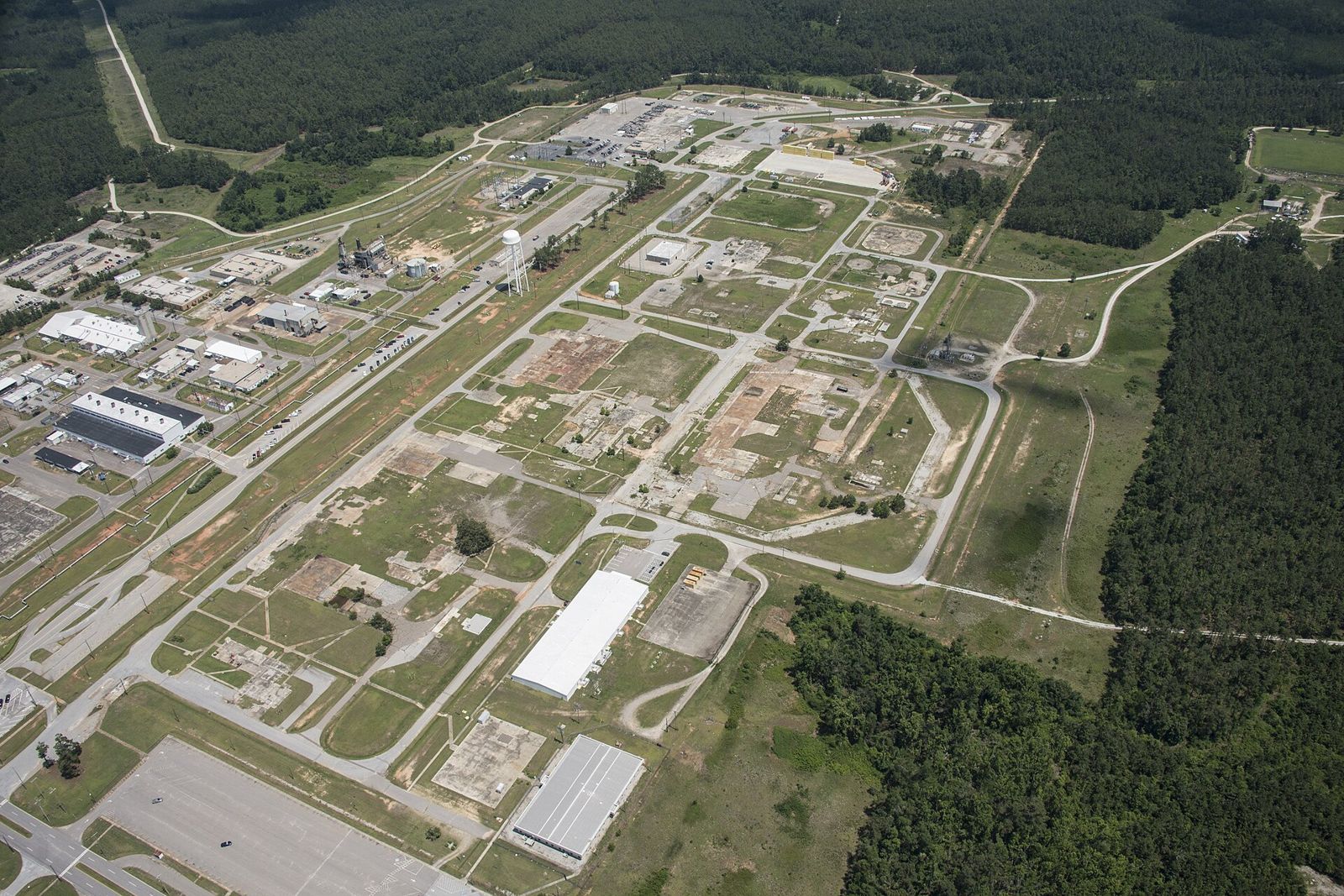
DOE moved first. An April 2025 request for information identified 16 potential DOE sites, and on July 24, 2025 the department selected four to move forward: Idaho National Laboratory, the Oak Ridge Reservation, the Paducah Gaseous Diffusion Plant and the Savannah River Site. Each then ran its own solicitation.
The logic is the same one that makes retired coal plant sites attractive. Former enrichment plants and weapons-complex land often come with large secured acreage, existing transmission, water infrastructure and a community used to heavy industry. DOE says the Paducah site’s existing transmission capacity, water infrastructure, fiber and available land can support large-scale AI infrastructure.
DOE Sites: Where Each One Stands
Status as reported in DOE and NNSA announcements unless noted. These are public projects, not benchmarks for what any other site is worth.
| Site | Solicitation and status | Project as announced |
|---|---|---|
| Savannah River Site, Aiken County, SC (NNSA) | RFP issued Sept. 30, 2025 for 10 tracts totaling 3,103 acres; proposals due Dec. 5, 2025. On July 20, 2026 NNSA selected Amentum (with DC Blox, per trade press) to negotiate a phased lease. | 1 GW data center with about 2 GW of on-site generation, natural gas bridging to nuclear. Selection is not a final lease award. |
| Paducah Site, KY (DOE Environmental Management) | Request for offers in November 2025. DOE announced Brookfield as campus developer and NextEra Energy as power developer (announcement dated Aug. 4, 2026). | 1.8 GW AI/HPC campus on about 785 leased acres; 2 GW new gas generation, up to 2.6 GW batteries, transmission upgrades. Power service agreement subject to Kentucky PSC approval; construction expected to finish in 2031. |
| Portsmouth Site, Pike County, OH (DOE) | Partnership with SoftBank and AEP Ohio announced March 20, 2026 (not one of the original four sites). | 10 GW data center development; SB Energy plans 10 GW of new generation including 9.2 GW of gas, and $4.2 billion with AEP Ohio for transmission. Construction expected to begin in 2026. |
| Idaho National Laboratory, ID (DOE) | Request for applications issued Sept. 9, 2025, applications due Nov. 7, 2025. | No developer award found in DOE announcements as of this update. |
| Oak Ridge Reservation, TN (DOE) | RFP issued Sept. 30, 2025 for two parcels. Local reporting says DOE received proposals but set Oak Ridge aside for now to focus on Portsmouth and Paducah. | DOE has said it hasn't ruled out future data centers there. |
NNSA said Savannah River proposals would be evaluated on technological readiness, financial viability and detailed plans to complete regulatory and permitting requirements, and that partners must secure their own utility interconnection agreements. It also stressed that selection for negotiations is not a final lease award; any agreement still needs permits, safety and security evaluations and other federal approvals.
Army Bases and BLM Land
Army enhanced-use leases
On March 26, 2026 the Army announced it had conditionally selected Carlyle for about 1,384 acres at Fort Bliss, Texas, and CyrusOne for about 1,201 acres at Dugway Proving Ground, Utah, to enter exclusive negotiations for commercial hyperscale data centers. The projects use the Army’s Enhanced Use Lease program under 10 U.S.C. 2667, which lets military departments lease non-excess property. The developers finance, build, operate, maintain and decommission the data centers. The Army projects initial operating capability in fiscal 2027 at Fort Bliss and fiscal 2029 at Dugway, with the Army Corps of Engineers running lease negotiations and environmental review. As with DOE, the selection isn’t a final deal.
Bureau of Land Management
BLM says that in June 2026 it approved the Townsite Data Center on 88.5 acres of public land near the existing Townsite Solar 1 project outside Boulder City, Nevada, citing EO 14318. The approval amended an existing solar right-of-way and relied on the solar project’s earlier environmental review. After Boulder City and environmental groups appealed, an Interior Board of Land Appeals judge stayed construction, writing that the two projects were fundamentally dissimilar in ways that require meaningful NEPA analysis. BLM then asked to set the approval aside for more review, and the board allowed it, according to the Las Vegas Review-Journal. The lesson for anyone counting on fast federal approvals: the executive order speeds process, but it doesn’t remove the environmental review the law still requires.
Site intake
Own private land with a real path to power?
Data center developers are paying premiums for powered land — get a realistic read on your parcel. Free, no obligation unless a deal closes.
Federal sites are chasing gigawatt campuses years out. If your parcel has nearby transmission, acreage and water, submit it for a confidential review of how it fits what developers are buying now. No obligation.
Your information is reviewed privately. A submission is not a listing, and it does not obligate you unless a deal closes.
What the Federal Deals Have in Common
- Leases, not sales. Every federal model so far is a long-term lease or right-of-way. The government keeps the land; the developer carries the capital and the decommissioning obligation.
- Bring your own power. Savannah River pairs a 1 GW data center with about 2 GW of on-site generation. Paducah adds 2 GW of gas generation and up to 2.6 GW of batteries for a 1.8 GW campus. Portsmouth plans 10 GW of generation for a 10 GW development. DOE frames these under the administration’s Ratepayer Protection Pledge, meaning the project pays for the energy infrastructure it needs instead of existing customers.
- The grid still has a say. Developers must secure utility interconnection agreements, and the Paducah power service agreement still needs Kentucky Public Service Commission approval. Big transmission upgrades, like the $4.2 billion SB Energy is investing with AEP Ohio, are part of the price of entry.
- Long timelines. Paducah’s construction is expected to finish in 2031. Even the faster Army schedule runs to fiscal 2027 and 2029.
- Balance sheets matter. The selected teams are large infrastructure investors and utilities. These aren’t opportunities for a small developer without capital partners.
What It Means for Private Landowners
You’re mostly not competing for the same deal
The federal sites are built around multi-gigawatt campuses that bring new generation and need years of permitting. Most private data center land deals involve smaller projects, a utility that can serve the load, and a developer who wants to start sooner. A parcel near a substation with a credible utility path is a different product from a federal site that needs its own power plant. The federal program doesn’t make that parcel less useful; if anything, it shows how much developers will go through to get large blocks of power.
Land near a federal campus may get calls
Gigawatt projects need new transmission lines, substations, gas laterals and construction access, and not all of that fits inside the federal fence line. If you own land between a federal site and the grid or a pipeline, expect survey requests and easement offers. Read our guides to transmission line easements and eminent domain before you sign anything, since an easement can limit what you can later do with the rest of your parcel.
The federal checklist is a good private checklist
Look at what DOE says made its sites attractive: transmission capacity, water infrastructure, fiber, available land, and a track record of heavy industrial use. Look at what NNSA scored: technological readiness, financial viability and a permitting plan. Those are the same things a buyer will test on private land. Our data center site selection criteria page turns them into a parcel scorecard.
Leasing is normal at this scale
Federal agencies chose ground leases partly because they can’t or won’t sell. Private owners have the choice. A sale gives you a clean exit; a long-term ground lease can keep you in the upside but ties you to the project for decades, including what happens at decommissioning. Our comparison of data center land lease vs. sale covers the trade-offs, and the federal leases are a reminder to insist on clear decommissioning and restoration terms either way.
What It Means for Developers
- Watch each agency’s own channel. DOE and NNSA have announced solicitations site by site, with industry days and short response windows. The Army runs its program through its Enhanced Use Lease program, with the Corps of Engineers handling lease negotiations.
- Lead with power. The DOE selections so far paired the data center with new generation, storage or transmission investment. A proposal that assumes the local utility will simply serve a gigawatt is unlikely to score well.
- Budget for NEPA. Federal land means federal review. The Nevada case shows a shortcut on environmental review can cost more time than it saves.
- Keep private options open. With awards conditional and timelines measured in years, many teams will want private sites in parallel. Federal and private land are complements, not substitutes.
Frequently Asked Questions
Which federal sites are being offered for AI data centers?
On July 24, 2025, DOE selected four sites to invite private partners for AI data center and energy projects: Idaho National Laboratory, the Oak Ridge Reservation in Tennessee, the Paducah Gaseous Diffusion Plant in Kentucky and the Savannah River Site in South Carolina. DOE has since announced a partnership at its Portsmouth Site in Ohio (March 2026). Separately, the Army conditionally selected developers for Fort Bliss, Texas and Dugway Proving Ground, Utah (March 2026), and BLM approved a data center right-of-way near Boulder City, Nevada in June 2026 that was later stayed on appeal and sent back for more review.
Can you buy federal land for a data center?
Generally not through these programs. The DOE and Army deals are long-term leases: NNSA's Savannah River solicitation invited proposals for long-term leasing agreements, DOE says the Paducah campus will sit on about 785 acres of leased land, and the Army's projects use enhanced-use leases under 10 U.S.C. 2667 on non-excess land. The developer finances, builds, operates and eventually decommissions the project.
Do federal data center sites come with power?
Mostly the developer has to bring it. NNSA said Savannah River partners must secure utility interconnection agreements, and the selected project pairs a 1 GW data center with about 2 GW of on-site generation. At Paducah, NextEra is to build 2 GW of new gas-fired generation and up to 2.6 GW of batteries for a 1.8 GW campus. At Portsmouth, SB Energy plans 10 GW of new generation, including 9.2 GW of natural gas, plus $4.2 billion in transmission upgrades with AEP Ohio.
Does Executive Order 14318 apply to private land?
Partly. The July 23, 2025 order directs agencies to speed federal permitting for qualifying data center projects, defined by thresholds such as more than 100 MW of new load or at least $500 million in committed capital expenditure, and to make suitable federal land available. Its permitting provisions can matter for private-land projects that need federal permits, such as wetlands permits, but the federal land sections cover DOE, Interior and Defense sites.
Do federal data center sites hurt the value of private land?
Not in any simple way. The federal sites are aimed at very large, gigawatt-scale campuses with long build-outs, such as Paducah's expected 2031 completion, and each needs new generation and transmission. Most private-land deals are different projects with different timelines. Land near a federal campus may also be approached for transmission, pipeline or other supporting easements. Value still comes down to a specific parcel's power, acreage, water and zoning.
Sources: The White House, Executive Order 14318, “Accelerating Federal Permitting of Data Center Infrastructure” (July 23, 2025); U.S. DOE, “DOE Announces Site Selection for AI Data Center and Energy Infrastructure Development on Federal Lands” (July 24, 2025); NNSA, “NNSA Seeks Proposals for AI Data Centers, Energy Projects at Savannah River Site” (Sept. 30, 2025) and “NNSA Selects Amentum for AI Data Center and Energy Project at Savannah River Site” (July 20, 2026); DCD coverage of the Amentum/DC Blox selection; DOE Office of Environmental Management, “Energy Secretary Announces New American Energy Hub at Paducah Site” (Aug. 4, 2026); DOE, “Energy Department Announces Partnership to Ensure Affordable Energy and Power America’s AI Future” (Portsmouth, March 20, 2026); Hellbender Press reporting on Oak Ridge (2026); U.S. Army, “Army reaches conditional agreement with private industry for hyperscaled data centers” (March 26, 2026); BLM Nevada, “Approved Decision of Townsite Data Center” (July 20, 2026); Las Vegas Review-Journal coverage of the IBLA stay and remand (2026). Figures are as reported by those sources and can change as negotiations continue. This page is general information, not legal, real estate or investment advice.
Site intake
Have land near transmission, a federal site or a retiring plant?
Data center developers are paying premiums for powered land — get a realistic read on your parcel. Free, no obligation unless a deal closes.
Submit it for a confidential review. We'll look at power, acreage, water, zoning and how it compares with what developers are buying. No obligation.
Your information is reviewed privately. A submission is not a listing, and it does not obligate you unless a deal closes.
Landowner path
Own power-adjacent land?
Guides on this site explain what developers look for. The intake is how you get a realistic read on a specific parcel — free, and no obligation unless a deal closes.
- What interconnection queues mean for landowners
- Land near substations
- Selling land to data center developers
- Site requirements
- Indiana
- Ohio
- North Carolina
- Georgia
- Texas
- Boone County, IN — Lebanon / LEAP
- St. Joseph County, IN — New Carlisle
- LaPorte County, IN — Kingsbury / Michigan City
- Licking County, OH — New Albany corridor
- Catawba County, NC — Maiden
- Richmond County, NC — Hamlet–Rockingham
- Submit your parcel